This animation shows how a Pelamis Wave Energy Converter works. I don't have any numbers on the cost per kilowatt hour for wave power but I have to say, it looks simple and cheap. What's more, wave energy is as reliable as the spinning of the earth. Also, in a scenario straight out of a cyberpunk novel, Google is looking to build massive off shore data centers powered by Pelamis Wave Energy Converters.
Wave Power
This animation shows how a Pelamis Wave Energy Converter works. I don't have any numbers on the cost per kilowatt hour for wave power but I have to say, it looks simple and cheap. What's more, wave energy is as reliable as the spinning of the earth. Also, in a scenario straight out of a cyberpunk novel, Google is looking to build massive off shore data centers powered by Pelamis Wave Energy Converters.
Monday, September 29, 2008
1 comments
Labels:
Wave Energy

Gov. Palin has it Right On Energy Policy
Sunday, September 7, 2008
0
comments
Obama's Shameful "Windfall" Tax On Oil Companies

Barack Obama will require oil companies to take a reasonable share of their record-breaking windfall profits and use it to provide direct relief worth $500 for an individual and $1,000 for a married couple. The relief would be delivered as quickly as possible to help families cope with the rising price of gasoline, food and other necessities. The rebates would be fully paid for with five years of a windfall profits tax on record oil company profits. This relief would be a down payment on Obama’s long-term plan to provide middle-class families with at least $1,000 per year in permanent tax relief. The Obama energy rebates will: offset the entire increase in gas prices for a working family over the next four months; or pay for the entire increase in winter heating bills for a typical family in a cold-weather state. In addition, Obama has proposed setting aside a portion of a second round of fiscal stimulus to ensure sufficient funding for home heating and weatherization assistance as we move into the fall and winter months.Hugo Chavez would be proud. Obama is using populist rhetoric to villanize oil companies in order to justify seizing their profits and using those profits to purchase votes. As Mark Perry points out on his blog, Oil Companies already pay more taxes than all the lower 50% of income earners combined and Exxon alone has paid over $20 billion in taxes in the first half of 2008. Where does it end?
Friday, August 8, 2008
0
comments
Labels:
Politics
Still No Northwest Passage

 Of course, there are still six weeks left in the melting season so some are still raising concerns about the "thinning ice" and still say we may have open waters at the North Pole this summer. Fat chance.
HT: DaveScott at Uncommon Descent
Wednesday, August 6, 2008
0
comments
Labels:
Climate Change
It Is Not The Great Depression

- Modern Media Much More Negative: During the week of the 1929 stock market crash, daily news stories reported positive news more often than negative by a 4-to-1 ratio. The week that the Bear Stearns fall occurred, coverage was the complete opposite. Negative stories on ABC, CBS and NBC outnumbered positive 6-to-1.
- No Good News: Roughly 40 percent of the stories from 2008 contained no positive comments at all. On CBS, that percentage was even higher. Completely negative stories made up nearly 60 percent of its reports.
- It’s Not A Depression: Today’s journalists are making repeated connections to the largest economic crisis in modern times – often with the phrase “not since the Great Depression.” Only a few of those comments explained the differences between today’s economy and the nation’s darkest economic years, or bothered to note that America is not in a depression.
- Old Presidents Never Die…: The claim that President George W. Bush would be the first president since Hoover to lose jobs in his first term proved false, yet journalists repeated it more often than Democratic operatives. Journalists have been comparing Republicans to Hoover for several years and have already begun doing so with Sen. John McCain, the presumptive GOP presidential nominee.
- CBS the Worst: CBS consistently appears among the worst media outlets on the economy. This study was no different. Business reporter Anthony Mason was even called “the grim reaper” by his own anchor Katie Couric. In 2008 during the week of the Bear Stearns collapse, negative stories on CBS outnumbered positive by an 11-to-1 ratio.
- NBC the Best: NBC’s attempts to deliver balanced economic coverage can be summed up in two words – Maria Bartiromo. The star of sister network CNBC was a cautious voice reminding viewers that negative news can have an impact. “We could talk ourselves into a recession,” she told NBC’s “Today.”
Greenspan: Regulation and Protectionism Not the Answer

It has become hard for democratic societies accustomed to prosperity to see it as anything other than the result of their deft political management. In reality, the past decade has seen mounting global forces (the international version of Adam Smith’s invisible hand) quietly displacing government control of economic affairs. Since early this decade, central banks have had to cede control of long-term interest rates to global market forces. Previously heavily controlled economies – such as China, Russia and India – have embraced competitive markets in lieu of bureaucratic edict. The danger is that some governments, bedevilled by emerging inflationary forces, will endeavour to reassert their grip on economic affairs. If that becomes widespread, globalisation could reverse – at awesome cost.The full article is here.
Tuesday, August 5, 2008
0
comments
Labels:
Economy
Adding a "Diesel Gene" Into Algae

Sunday, August 3, 2008
0
comments
Labels:
Algae Fuel
Solar Energy Storage Breakthrough at MIT

The problem of how to store solar energ—or any energy at a large scale—is very real. Batteries are simply too expensive and don't yet have enough capacity. The Andasol solar thermal plant in Spain will test one interesting option later this year: Liquid heated by its mirrors will be stored in what is essentially a giant Thermos, so that the plant can continue to generate six hours of electricity each night. Abengoa recently announced a similar plant in Arizona; thermal storage will power the air-conditioning usage peak that continues after sunset in the Southwest.The fact that they are using heat as a means to store solar energy in Spain is an indication of how sorely needed an efficient energy storage method is needed. Nocera's invention appears to just such a method and this is why it is being greeted with a significant amount of press and media attention.
Nocera's scheme has several advantages, though. Because it can work on a small scale, it's suitable for distributed power in homes.
Saturday, August 2, 2008
0
comments
Labels:
Solar Energy
Venter Hopes For Fourth Generation Biofuel This Year
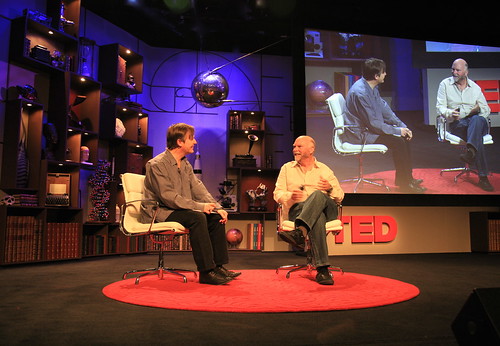
[D]uring his talk, Venter sketched out a plan to copy genes from deep-sea microbes to produce organisms that could slurp up highly concentrated carbon dioxide and spew out hydrogen gas–killing two environmental birds with one stone by simultaneously providing clean energy and drawing down current levels of greenhouse gases in the atmosphere to more bearable levels. The first step towards this goal will be to compose a genome on a computer, synthesize it from scratch, and insert it into a microbe without killing it. I’ve been wondering when Venter will take that step (see my conversation with him last fall on Bloggingheads.tv). Back then, Venter said some time in 2008. During the Q&A after his talk, I asked how the experiment was going. He said he still hoped to finish it this yearThis year. Or within 5 months. They must be making significant progress if he hopes to have it done that soon. Which is good because I am getting impatient.
On another note, I have been describing Venter's "fourth generation biofuels" as genetically modified algae, Venter himself has referred to them as "genetically engineered algae." From the description given in Discover Magazine it sounds like the organism will have a completely synthetic genome. More accurately it is a genome of pre-existing genes compiled in a novel way. On the other hand, the organism mentioned above also produces hydrogen? The genetically engineered algae are designed to produce oil. Maybe the reporter got it wrong or maybe Venter is referring to a different project.
Thursday, July 31, 2008
0
comments
Labels:
Algae Fuel
Coalition Deaths Continue to Decline in Iraq
 The above graph illustrates the decline in coalition deaths from hostile activity in Iraq since "the Surge" began in May of 2007. Since the beginning of "the Surge," hostile deaths have declined from 123 in May of 2007 to 8 in July of 2008. Additionally this continued decline in violence is occurring even as the five surge brigades have left Iraq. See the link here for more statistics.
0
comments
Labels:
War
Craig Venter's Fourth Generation Biofuels From Algae

By far, this is the most promising scenario for algae fuel that I have heard. However, few details have been divulged and it is difficult to know how much progress has actually been made. Today, Popular Mechanics posted a brief interview with Craig Venter describing fourth generation biofuels. The good parts of the interview are excerpted below, the rest of the interview is rather tedious as Venter expresses his total buy-in to the man made global warming hypothesis and how great he thinks Jimmy Carter was as a President.
And the fourth-generation fuels?Trying to read between the lines, it sounds as if Synthetic Genomics already has the modified algae that secrete the oils they are interested in manufacturing and they are now looking for a way to grow this organism on a commercial basis. At any rate, developments regarding this technology are eagerly awaited.
We're using a unique type of algae that we've genetically engineered to turn sunlight and CO2 into C8 and C10 and larger lipids. The people that initially grew algae viewed it as farming—you know, you grow a bunch of algae and then you harvest it. But it's totally different if the algae are chemical factories. Ours continuously secrete these molecules, so we get constant production of something that can basically be used right away as biodiesel.
So they perform better than traditional biofuels—but will they actually be better for the environment?
Because we actually have to feed them concentrated CO2, we can take CO2 streams from power plants, cement plants and other places. People view CO2 as a contaminant—they want to bury it in the ground or pump it into wells to hide or sequester it. We want to take all that waste product and convert it into fuel.
When do you hope to have these fuels in people's cars?
Our goal is to have multiple things on the market within five years. We're looking now at how to scale this up. Our molecules are much higher energy density [than ethanol], but even so we need to produce hundreds of billions of gallons if we're really going to make a dent in oil use.
Wednesday, July 30, 2008
5
comments
Labels:
Algae Fuel
PetroAlgae's Centrifuge Oil Extraction Method
What's the problem?The question I have is what is more efficient; extracting and then refining the oil like PetroAlgae or just throwing it in the gasifier like David James?
It's expensive. Tom Byrne, on the board of directors of the nonprofit Algal Biomass Organization, said a pilot plant can cost from $50 million to $100 million, but as long as petroleum stays above $50 a barrel, algae can be competitive.
How's the oil harvested?
The algae are grown to their maximum density -- when their water turns a deep forest green, either in open pools or closed systems encased in plastic tubes or tanks. The water is drained and the paste is milled to separate the oil from its "meal." The crude oil is then refined at a biodiesel facility.
Tuesday, July 29, 2008
0
comments
Labels:
Algae Fuel
Ride The Lightning

As oil becomes more expensive, it is becoming apparent that the most efficient method of powering our cars is electricity. An electric car is not only more efficient in the use of energy than a gasoline car, it is agnostic to the source of electricity and will therefore be relatively immune to the fluctuations in fuel price that afflict cars powered by a distinct type of fuel, i.e. gasoline, diesel, or natural gas. The problem with the electric car is that they typically have a limited range, take a long time to recharge, are underpowered, and look more like a an eco-fashion statement than a car. All of that may be about to change. Pictured above is the Lightning GT from the UK automotive company Lightning. The Lightning GT is an electric car that is powered by four electric motors, one at each wheel, that combine for 700 hp. It does zero to sixty in four seconds. The Lightning GT has 30 batteries made of lithium-titanate nanoparticles, which give the car an advertised range of over 185 miles and take only 10 minutes to recharge. 185 miles is far less than a gasoline engine but it is further than most people drive in a day. Since you can recharge it at home, visiting a gas station will be a thing of the past except on longer trips where drivers will have to stop every 185 miles or so to recharge for 10 minutes. The GT Lightning is expected to be available in early 2009 at a price of about $250,000, so it is not exactly economical. However, I remember when a CD player cost $10,000. Hopefully volume production and maturation of the technology will drive the cost of a car like the Lightning GT down to a price competitive with an internal combustion engine car.
UPDATE: Motortrend has reported that the Lightning GT has a range of 250 miles. If true, that is an impressive range on par with many internal combustion engine vehicles. Most likely, Motortrend has their facts wrong. Nonetheless, the possibility that it is accurate makes it worth a mention.
0
comments
Labels:
Electric Cars
Plasma Gasification
David James does it with algae in his backyard but the video above shows the potential for major industrial application of gasification as well as a very nice explanation of how gasification works.
Thursday, July 24, 2008
1 comments
Labels:
Gasification
Fuel From Algae By Gasification
The production values in the above video are horribly low. However, it is interesting enough to post. In the video, David James explains his gasification method and how he makes gasoline or diesel directly from dried algae in about five minutes. Gasification eliminates the need to extract oil from the algae because the algae is vaporized by the heat of the gasifier. According to James, after the algae is vaporized it is then converted directly to gasoline through the use of proprietary catalysts. I would really like to see a video of his gasifier in action but I haven't been able to find one.
Wednesday, July 23, 2008
0
comments
Labels:
Algae Fuel
Headmaster Makes Algae Gasoline for $1.90 a Gallon

David James, the principal of a private school in Opelika, Alabama, is not content to merely administer the school. No, he wants to make the schools energy as well. He uses biodiesel from algae to run the school's buses and machinery. Pictured above is James at his algae growing operation at Eastwood Christian School. According to a report at RedOrbit, James claims to efficiently make gasoline from algae using a gasifier.
It takes about 13 pounds of algae, which James is growing in a greenhouse, to make a gallon of gas, which they can make for an estimated $1.50 to $1.90 a gallon, he said. He also said an acre of algae, in the low estimates, could yield five to six thousand gallons of fuel.According to James, a gasifier is the best way to make fuel from algae,
"The answer is gasification. ... I believe the gasifier is the way of the future," he said.Some tantalizing quotes about the potential of algae fuels but I wouldn't bank on those numbers just yet. For more see the report at RedOrbit.
Gasification is a process of converting biomass into carbon monoxide and hydrogen by exposing it to high temperatures with a certain amount of oxygen or steam.
...
He said his friend at Unified Fuels, Inc. was the engineer who had built the gasifier they were converting the algae in and the specific catalysts they were using in the system were patented.
Tuesday, July 22, 2008
0
comments
Labels:
Algae Fuel
Solazyme's Sugar Eating Algae
The above video shows Solazyme's mehod for creating oil from algae. It is one of the nicest productions so far regarding algae. Solazyme's algae does not use photosynthesis, which would seem to defeat the whole point of using algae for fuel. The offered reason for not using photosynthesis is that the algae produces oil more efficiently when using sugars. It seems that statement would depend on your definition of efficient. The sugars that these algae eat has to come from somewhere, so somewhere in the chain it uses land and sunlight. However, Solazyme claims that their process uses cellulosic sugars from non-food stocks. I wonder if the process can use cellulosic food stocks now or if that is something they are working towards? Anyway, it is a good video but I have become convinced that a photosynthetic algae will be the best solution. In particular, I am waiting anxiously for Craig Venter's group at Synthetic Genomics to produce their fourth generation biofuel.
Monday, July 21, 2008
1 comments
Labels:
Algae Fuel
Boeing Bullish on Biofuel from Algae

"It makes extremely good jet fuel," said Darrin Morgan, Boeing's director of business analysis for environmental strategy. ...My question is why only 5 to 10% in seven years? Why not more faster? Is it the cost or is it the lack of production capacity? See the full article in the Seattle Times and another piece on the same topic in the New York Times, both of which focus on boring environmentalism and never bother to talk about the business case for algae fuel.
"It grows naturally in an aquatic environment; it doubles in mass every day; it's very plant-oil dense," he said.
Morgan said the algae — grown either in shallow ponds or closed tanks — is so productive that the entire supply of fuel for the world's fleet of commercial jets could be provided in a cultivated area about the size of West Virginia.
"Of course, West Virginia may not be the right place," he deadpanned. He envisages ideal cultivation areas in such places as Australia or the desert Southwest of the United States, where crops won't grow and salty aquifers or the sea provide reusable water. ...
Morgan said Boeing isn't planning to go into the fuel business, but it will do everything it can to promote research so extracting oil from algae becomes commercially viable on a large scale. ...
Boeing's rosy forecast is that as much as 5 to 10 percent of aviation fuel could come from this source by 2015.
Sunday, July 20, 2008
1 comments
Labels:
Algae Fuel
Ford to Manufacture European Cars in America
The Wall Street Journal is reporting that Ford will retool its U.S. factories to manufacture European cars for the domestic market. Ford believes the smaller more fuel efficient cars it sells in Europe, such as the Mondeo pictured above, will do well under the current economic conditions in the United States. Europe has been a bright spot for Ford, its main European markets rose 2% in the year's first half while its U.S. sales dropped 14% in the same period. From the WSJ article:

By making its European models in U.S. plants, Ford can avoid the foreign-exchange impact and sell the vehicles at more attractive prices.I think this is a no-brainer for Ford. However, I wonder why they don't manufacture in the U.S. for the European market? With the lower cost of employment and favorable exchange rate you would think that exporting from the U.S. to Europe would work well. It seems to work for BMW, as I reported previously. If Ford doesn't export cars from America to Europe, my guess is that it is because the labor unions in the U.S. make it uncompetitive. BMW makes it work but those are newer and undoubtedly nonunion factories that it uses.
The move was pushed by Chief Executive Alan Mulally and met resistance from others in the company, people familiar with the matter said. Opponents questioned whether Ford can meet the timetable for the effort -- possibly as soon as 18 months -- and worried it could ultimately fail, as did previous efforts by Ford to sell European models in the U.S., these people said.
But Mr. Mulally, who spent his career at Boeing Co. before taking over the second-largest U.S. auto maker in 2006, decided to push ahead, they said.
Saturday, July 19, 2008
0
comments
Labels:
Outsourcing
Subscribe to:
Posts (Atom)

