
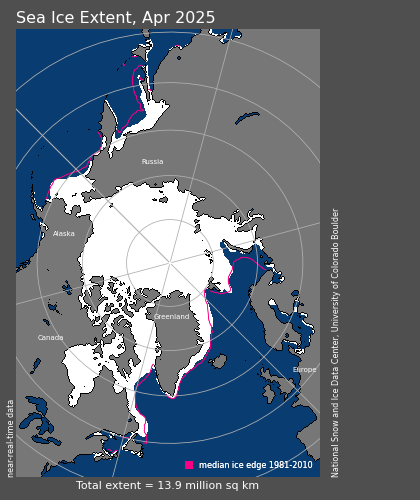
 Of course, there are still six weeks left in the melting season so some are still raising concerns about the "thinning ice" and still say we may have open waters at the North Pole this summer. Fat chance.
HT: DaveScott at Uncommon Descent
Of course, there are still six weeks left in the melting season so some are still raising concerns about the "thinning ice" and still say we may have open waters at the North Pole this summer. Fat chance.
Wednesday, August 6, 2008
0
comments
Labels:
Climate Change


The graphic above is a NASA prediction circa March 2006 of when solar cycle 24 would arrive. Click here or on the graphic for a larger image. As you can see from the graph, solar cycle 24 was expected to begin in late 2006 or early 2007. It is now March of 2008 and solar cycle 24 has not arrived. The latest solar observations, photographs of which are posted here, continue to show that there are still zero sunspots. According to NASA's prediction, we were expected to be well into solar cycle 24 and experiencing upwards of thirty sunspots per month at this time.
Thursday, March 13, 2008
0
comments
Labels:
Climate Change
It is believed that sunspots play a roll in temperature here on earth. Basically, the theory is the more sunspots the warmer it gets on earth. This commentary on the relationship is from the National Weather Service:
From the mid 1600s to early 1700s, a period of very low sunspot activity (known as the Maunder Minimum) coincided with a number of long winters and severe cold temperatures in Western Europe, called the Little Ice Age. It is not known whether the two phenomena are linked or if it was just coincidence. The reason it is hard to relate maximum and minimum solar activity (sunspots) to the Earth's climate, is due to the complexity of the Earth's climate itself. For example, how does one sort out whether a long-term weather change was caused by sunspots, or maybe a coinciding El Nino or La Nina? Increased volcanic eruptions can also affect the Earth's climate by cooling the planet. And what about the burning of fossil fuels and clear cutting rain forests? One thing is more certain, sunspot cycles have been correlated in the width of tree ring growth. More study will be conducted in the future on relating sunspot activity and our Earth's climate.The photograph of the sun taken above is from a link that updates with the latest photograph of the sun. As you can see, there are no sunspots. And there have been almost zero over the last couple of weeks. The last solar cycle has mostly ended and typically a new one would have begun. But it hasn't happened. The end of the last solar cycle and the current absence of sunspots coincides with the largest drop in temperature over a 12 month period in recored history. This is a record drop in temperature correlating with a record absence of sunspots. In my opinion the correlation between low sunspots and a drop in temperatures, both now and during the Maunder Minimum or "little ice age", bolsters the argument for causation.
The Solar Cycle: Sunspots increase and decrease through an average cycle of 11 years. Dating back to 1749, we have experienced 22 full solar cycles where the number of sunspots have gone from a minimum, to a maximum and back to the next minimum, through approximate 11 year cycles. We are now well into the 23rd cycle, with the 24th cycle right around the corner. The number of sunspots in this cycle reached a peak in May, 2000 where the number of sunspots were measured at near 170. A secondary sunspot maximum occurred near the beginning of 2002 where the sunspot number was about 150. The next sunspot minimum is forecast to occur in late 2006 through mid 2007.
Wednesday, February 27, 2008
0
comments
Labels:
Climate Change

All four major global temperature tracking outlets (Hadley, NASA's GISS, UAH, RSS) have released updated data. All show that over the past year, global temperatures have dropped precipitously.Go here for the full article.
Meteorologist Anthony Watts compiled the results of all the sources. The total amount of cooling ranges from 0.65C up to 0.75C -- a value large enough to erase nearly all the global warming recorded over the past 100 years. All in one year time. For all sources, it's the single fastest temperature change ever recorded, either up or down.
Tuesday, February 26, 2008
0
comments
Labels:
Climate Change
Is the Northern Hemisphere winter of 2007/2008 the coldest winter in 40 years? According to an article at the National Post it may be.
Snow cover over North America and much of Siberia, Mongolia and China is greater than at any time since 1966.
The U.S. National Climatic Data Center (NCDC) reported that many American cities and towns suffered record cold temperatures in January and early February. According to the NCDC, the average temperature in January "was -0.3 F cooler than the 1901-2000 (20th century) average."
China is surviving its most brutal winter in a century. Temperatures in the normally balmy south were so low for so long that some middle-sized cities went days and even weeks without electricity because once power lines had toppled it was too cold or too icy to repair them.
There have been so many snow and ice storms in Ontario and Quebec in the past two months that the real estate market has felt the pinch as home buyers have stayed home rather than venturing out looking for new houses.
In just the first two weeks of February, Toronto received 70 cm of snow, smashing the record of 66.6 cm for the entire month set back in the pre-SUV, pre-Kyoto, pre-carbon footprint days of 1950.
0
comments
Labels:
Climate Change


