
Adding a "Diesel Gene" Into Algae
Sunday, August 3, 2008
0
comments
Labels:
Algae Fuel

Solar Energy Storage Breakthrough at MIT

The problem of how to store solar energ—or any energy at a large scale—is very real. Batteries are simply too expensive and don't yet have enough capacity. The Andasol solar thermal plant in Spain will test one interesting option later this year: Liquid heated by its mirrors will be stored in what is essentially a giant Thermos, so that the plant can continue to generate six hours of electricity each night. Abengoa recently announced a similar plant in Arizona; thermal storage will power the air-conditioning usage peak that continues after sunset in the Southwest.The fact that they are using heat as a means to store solar energy in Spain is an indication of how sorely needed an efficient energy storage method is needed. Nocera's invention appears to just such a method and this is why it is being greeted with a significant amount of press and media attention.
Nocera's scheme has several advantages, though. Because it can work on a small scale, it's suitable for distributed power in homes.
Saturday, August 2, 2008
0
comments
Labels:
Solar Energy
Venter Hopes For Fourth Generation Biofuel This Year
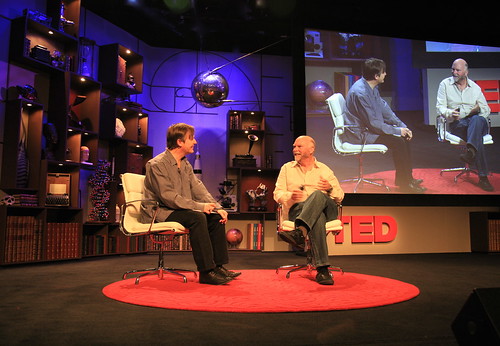
[D]uring his talk, Venter sketched out a plan to copy genes from deep-sea microbes to produce organisms that could slurp up highly concentrated carbon dioxide and spew out hydrogen gas–killing two environmental birds with one stone by simultaneously providing clean energy and drawing down current levels of greenhouse gases in the atmosphere to more bearable levels. The first step towards this goal will be to compose a genome on a computer, synthesize it from scratch, and insert it into a microbe without killing it. I’ve been wondering when Venter will take that step (see my conversation with him last fall on Bloggingheads.tv). Back then, Venter said some time in 2008. During the Q&A after his talk, I asked how the experiment was going. He said he still hoped to finish it this yearThis year. Or within 5 months. They must be making significant progress if he hopes to have it done that soon. Which is good because I am getting impatient.
On another note, I have been describing Venter's "fourth generation biofuels" as genetically modified algae, Venter himself has referred to them as "genetically engineered algae." From the description given in Discover Magazine it sounds like the organism will have a completely synthetic genome. More accurately it is a genome of pre-existing genes compiled in a novel way. On the other hand, the organism mentioned above also produces hydrogen? The genetically engineered algae are designed to produce oil. Maybe the reporter got it wrong or maybe Venter is referring to a different project.
Thursday, July 31, 2008
0
comments
Labels:
Algae Fuel
Coalition Deaths Continue to Decline in Iraq
 The above graph illustrates the decline in coalition deaths from hostile activity in Iraq since "the Surge" began in May of 2007. Since the beginning of "the Surge," hostile deaths have declined from 123 in May of 2007 to 8 in July of 2008. Additionally this continued decline in violence is occurring even as the five surge brigades have left Iraq. See the link here for more statistics.
0
comments
Labels:
War
Craig Venter's Fourth Generation Biofuels From Algae

And the fourth-generation fuels?Trying to read between the lines, it sounds as if Synthetic Genomics already has the modified algae that secrete the oils they are interested in manufacturing and they are now looking for a way to grow this organism on a commercial basis. At any rate, developments regarding this technology are eagerly awaited.
We're using a unique type of algae that we've genetically engineered to turn sunlight and CO2 into C8 and C10 and larger lipids. The people that initially grew algae viewed it as farming—you know, you grow a bunch of algae and then you harvest it. But it's totally different if the algae are chemical factories. Ours continuously secrete these molecules, so we get constant production of something that can basically be used right away as biodiesel.
So they perform better than traditional biofuels—but will they actually be better for the environment?
Because we actually have to feed them concentrated CO2, we can take CO2 streams from power plants, cement plants and other places. People view CO2 as a contaminant—they want to bury it in the ground or pump it into wells to hide or sequester it. We want to take all that waste product and convert it into fuel.
When do you hope to have these fuels in people's cars?
Our goal is to have multiple things on the market within five years. We're looking now at how to scale this up. Our molecules are much higher energy density [than ethanol], but even so we need to produce hundreds of billions of gallons if we're really going to make a dent in oil use.
Wednesday, July 30, 2008
5
comments
Labels:
Algae Fuel
PetroAlgae's Centrifuge Oil Extraction Method
What's the problem?The question I have is what is more efficient; extracting and then refining the oil like PetroAlgae or just throwing it in the gasifier like David James?
It's expensive. Tom Byrne, on the board of directors of the nonprofit Algal Biomass Organization, said a pilot plant can cost from $50 million to $100 million, but as long as petroleum stays above $50 a barrel, algae can be competitive.
How's the oil harvested?
The algae are grown to their maximum density -- when their water turns a deep forest green, either in open pools or closed systems encased in plastic tubes or tanks. The water is drained and the paste is milled to separate the oil from its "meal." The crude oil is then refined at a biodiesel facility.
Tuesday, July 29, 2008
0
comments
Labels:
Algae Fuel
Ride The Lightning

As oil becomes more expensive, it is becoming apparent that the most efficient method of powering our cars is electricity. An electric car is not only more efficient in the use of energy than a gasoline car, it is agnostic to the source of electricity and will therefore be relatively immune to the fluctuations in fuel price that afflict cars powered by a distinct type of fuel, i.e. gasoline, diesel, or natural gas. The problem with the electric car is that they typically have a limited range, take a long time to recharge, are underpowered, and look more like a an eco-fashion statement than a car. All of that may be about to change. Pictured above is the Lightning GT from the UK automotive company Lightning. The Lightning GT is an electric car that is powered by four electric motors, one at each wheel, that combine for 700 hp. It does zero to sixty in four seconds. The Lightning GT has 30 batteries made of lithium-titanate nanoparticles, which give the car an advertised range of over 185 miles and take only 10 minutes to recharge. 185 miles is far less than a gasoline engine but it is further than most people drive in a day. Since you can recharge it at home, visiting a gas station will be a thing of the past except on longer trips where drivers will have to stop every 185 miles or so to recharge for 10 minutes. The GT Lightning is expected to be available in early 2009 at a price of about $250,000, so it is not exactly economical. However, I remember when a CD player cost $10,000. Hopefully volume production and maturation of the technology will drive the cost of a car like the Lightning GT down to a price competitive with an internal combustion engine car.
0
comments
Labels:
Electric Cars

